

Faucet spout reach is one of the most important dimensions when selecting or specifying a faucet, especially for projects where usability, splash control, and sink compatibility must be consistent across multiple installations. In simple terms, spout reach tells you how far the water outlet extends over the sink or basin. If the reach is too short, water may land too close to the back wall and cause splashing or awkward hand placement. If the reach is too long, water can hit too close to the front edge, increasing splash and making the sink feel cramped.
This guide explains exactly how to measure spout reach, how to interpret manufacturer drawings, and how to choose the right reach for different sink shapes and installation constraints. For reference, you can review EBT’s spout options here: tubular spout.
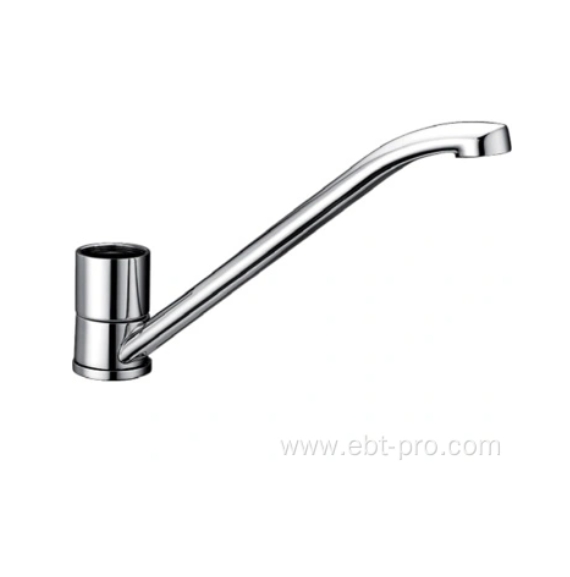
What Spout Reach Means In Real Use
Spout reach is the horizontal distance from the faucet’s mounting reference point to the point where water exits the spout. That distance determines the “landing zone” of the water stream inside the sink. The landing zone affects:
- Where hands naturally sit during washing
- Whether large pots can fit under the spout comfortably
- How much splash occurs when water hits the sink surface
- How easy it is to rinse all corners of the basin
For installations like commercial restrooms, hospitality projects, and multi-unit residential builds, spout reach is also a consistency dimension. If reach varies across units, the user experience changes even when the faucet style looks the same. That is why reach should be measured and specified clearly during selection and procurement.
Tools And Preparation Before Measuring
You can measure spout reach with simple tools. The key is to measure from the correct reference point and keep the tape level.
Recommended tools:
- Tape measure with clear markings
- Straightedge or ruler for alignment
- Pencil and masking tape for marking reference points
- Level, optional but helpful for precision
Preparation steps:
- Identify how the faucet mounts. Some faucets mount on the sink deck, some mount on a countertop, and some are wall-mounted.
- Confirm whether you are measuring an installed faucet or reading from a technical drawing.
- If measuring an installed faucet, clean and dry the area so you can mark points accurately.
A small setup step that improves accuracy is placing a strip of masking tape on the deck or wall where you will mark the centerline and measurement points. It prevents smudged marks and improves repeatability.
Step-By-Step: How To Measure Faucet Spout Reach On An Installed Faucet
Spout reach is measured horizontally, not along the curve of the spout. The most reliable method is to measure from the faucet’s mounting centerline to the aerator center.
Step 1: Identify the mounting reference point
For deck-mounted faucets, the reference point is usually the center of the faucet base or the center of the mounting hole. For single-hole faucets, this is straightforward. For widespread faucets, the spout may have its own mounting hole, and you measure from the center of that spout mounting point.
Step 2: Find the water outlet point
The outlet point is usually the center of the aerator, or the center of the spout opening if there is no aerator. This is the point that determines where water exits.
Step 3: Measure the horizontal distance
Hold the tape measure level and measure the straight horizontal distance from the mounting centerline to the outlet center. Do not follow the spout curve. If the spout is angled, align your tape so the measurement is horizontal.
Step 4: Record reach and note the faucet orientation
Write down the reach and whether the faucet is installed square to the sink. A slightly rotated faucet can change where water lands even if the reach is correct.
Step 5: Confirm the water landing zone
Turn on the faucet briefly and observe where the stream lands. A correct reach usually places the stream near the center of the sink bowl, not against the back wall and not too close to the front edge.
If you are measuring multiple units, measure at least three installations and compare results. Small differences can indicate inconsistent mounting positions or varying sink hole placement.
How To Measure Spout Reach From A Spec Sheet Or Technical Drawing
Manufacturers often show spout reach on line drawings. The key is to identify the same reference points used in installed measurement.
In technical drawings, reach is typically:
- A horizontal dimension line
- Starting at the center of the mounting point or spout centerline
- Ending at the center of the aerator or water outlet
How to verify you are reading the correct dimension:
- Look for a labeled “Reach” line or a horizontal arrow measurement to the spout outlet.
- Confirm the measurement is not the overall spout length. Overall length follows the body and can be longer than reach.
- Confirm the drawing uses consistent units, often inches or millimeters.
If you do not see a reach label, you can still estimate it by identifying the centerline of the mounting and the outlet center and measuring that horizontal gap using the drawing scale. For project procurement, it is better to request a drawing that explicitly labels reach so specification is unambiguous.
Reach, Height, And Clearance: Related Dimensions You Should Check Together
Spout reach alone does not guarantee good usability. You should evaluate reach together with spout height and sink depth to avoid splash and clearance problems.
Key related dimensions:
- Spout height: vertical distance from mounting surface to outlet
- Aerator height above sink rim: affects splash potential
- Sink depth and bowl geometry: deeper sinks reduce splash risk
- Faucet setback: how far the faucet mounts from the sink bowl edge
A practical rule is that a very high spout combined with a long reach can increase splash if the sink is shallow. Meanwhile, a short reach with a low spout can feel cramped and limit washing space. The best combination is a reach that targets the center of the bowl with a height that provides enough clearance for normal tasks without creating excessive drop distance.
Choosing The Right Spout Reach For Different Sink Layouts
The “right” spout reach depends on sink size and how the faucet is positioned relative to the bowl. The table below gives selection guidance that helps you avoid common mismatches.
| Sink Type Or Layout | Typical Goal For Water Landing Zone | Reach Selection Guidance | Common Mistake To Avoid |
|---|---|---|---|
| Compact bathroom basin | Near bowl center, slightly rear of center | Moderate reach to avoid front splash | Reach too long, stream hits near front edge |
| Standard kitchen sink | Center of main bowl | Reach that targets bowl centerline | Reach too short, stream hits back wall area |
| Deep single bowl | Center to slightly forward | Longer reach acceptable due to depth | Very high spout creates extra splash |
| Double bowl kitchen sink | Center of intended primary bowl | Reach aligned with the chosen bowl | Misalignment causes stream landing between bowls |
| Wall-mounted faucet | Center of bowl from wall reference | Reach matched to wall-to-bowl distance | Underestimating wall setback and sink depth |
For project applications with varied sink models, selecting a spout family with multiple reach options is often the most efficient approach. It allows you to standardize styling while matching geometry to different basins.
Common Measurement Errors And How To Avoid Them
Many reach mistakes come from measuring the wrong points or mixing dimensions from different reference lines.
Common errors:
- Measuring from the back wall instead of the mounting centerline
This creates inconsistent results because wall distance varies by installation. - Measuring along the spout curve
Spout length is not reach. Only the horizontal projection matters. - Measuring to the tip of the spout rather than the outlet center
The outlet center is where water exits. Decorative tips can extend beyond it. - Ignoring faucet rotation and mounting location
A rotated faucet changes landing zone even if reach is correct. - Using sink rim center as the reference
Reach should be based on faucet mounting centerline, not sink symmetry.
If your goal is consistent installation across multiple sites, define the measurement method in your specification documents. That reduces interpretation differences between installers and reviewers.
How EBT Supports Spout Reach Specification And Customization
For projects that require consistent fit and performance, EBT provides spout solutions designed for clear specification and practical integration. If you need a tubular spout for different basin sizes or different mounting conditions, we can support guidance on reach selection, drawing confirmation, and configuration planning. We also support customization options to align spout geometry with your product requirements, including dimensional matching and finish coordination.
You can review EBT’s spout selection here: tubular spout.
Conclusion
To measure faucet spout reach correctly, measure the horizontal distance from the faucet mounting centerline to the center of the water outlet, typically at the aerator. Do not measure along the curved spout, and do not use the wall or sink rim as the main reference. Once you have the reach, confirm that the water stream lands near the center of the bowl and check related dimensions such as spout height and sink depth to control splash and improve usability.
If you are selecting spouts for a project and want help confirming the correct reach for your sink layout, contact EBT. Share your sink dimensions, mounting method, and target landing zone, and we can provide practical guidance and customization support based on our tubular spout options.